

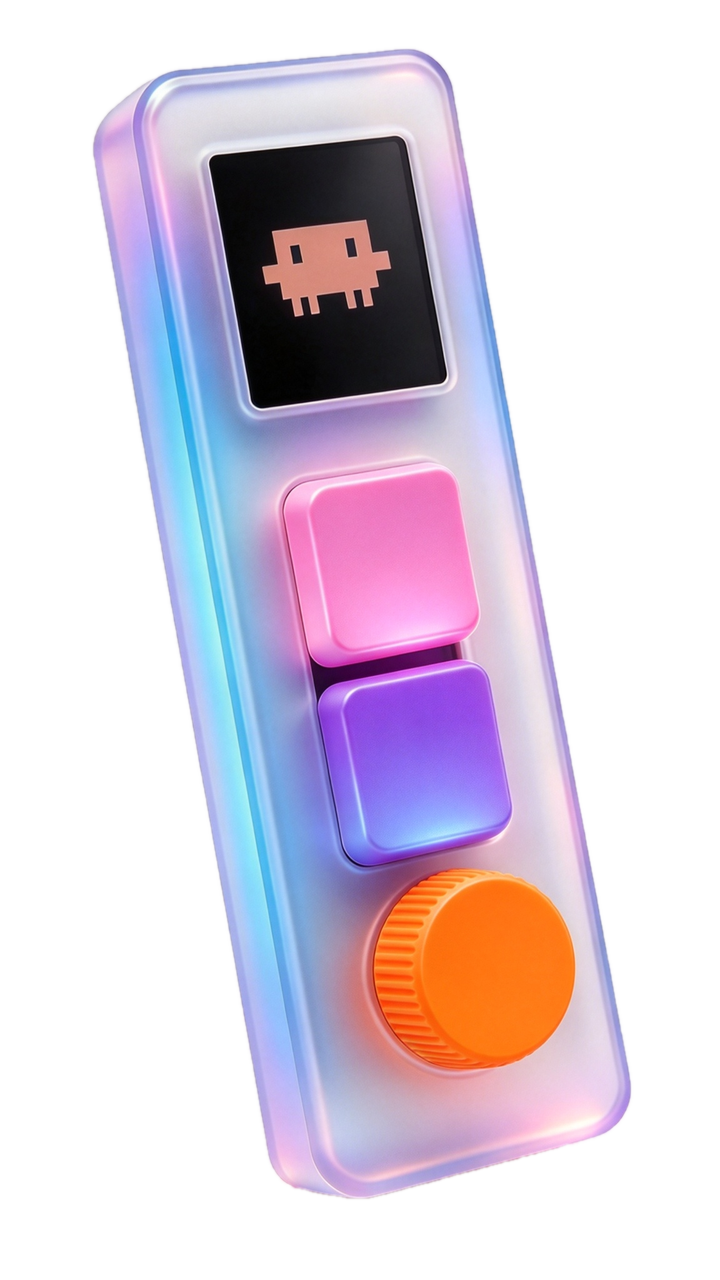
In our previous article, we explored how Vibokey seamlessly merges hardware and software to streamline complex AI collaboration workflows right at your fingertips. As an AI collaboration tool designed for ultimate productivity, our engineering team engaged in an intense internal debate over a seemingly small yet critical hardware detail during development:
When engaging in AI voice interaction, should the voice key be designed as Push-to-Talk—press and hold to speak, release to send—or Toggle Mode—click once to record, click again to stop?
At first glance, a hands-free toggle switch seems more convenient or tech-forward. However, after extensive testing across real-world office environments and user interviews, we came to a definitive conclusion: for a truly efficient AI collaboration tool, Push-to-Talk is hands-down the best solution for AI voice interaction.
In this article, we’ll dive deep into the design philosophy behind Vibokey across three dimensions: psychological security, signal-to-noise ratio, and blind-operation efficiency.
1. Psychological Security: Eliminating “Is It Eavesdropping?” Anxiety
With smart speakers and voice assistants so prevalent today, many users experience a subtle sense of anxiety during AI voice interaction: after speaking, you’re never quite sure if the device is still listening, or if your side comments while waiting for an AI response are being recorded.
This implicit anxiety caused by “status opacity” is an inherent flaw of Toggle Mode:
- Toggle Mode: Click once to record, click again to stop. Users must constantly check the screen or RGB light to verify whether recording is active. Forgetting to click again while pausing to think causes the device to capture unnecessary background noise.
- Push-to-Talk: Press to trigger, release to cut off. Physical pressure directly maps to the digital recording state.
On Vibokey, the moment your finger presses the K1 voice key, you know that AI voice interaction has started. The moment your finger naturally lifts, the circuit physically disconnects and voice transmission stops. This sense of control and privacy security, built into muscle memory, is something no UI indicator can replace.
2. Real-World Signal-to-Noise Ratio: Giving AI the Sounds That Matter
Although modern speech-to-text systems and large language models are becoming more capable, they remain highly sensitive to input quality. At a desk, while pacing, or in a café, real environments are full of uncontrollable sounds: nearby conversations, keyboard clicks, coughs, and even verbal fillers such as “uh” and “well.”
Toggle recording can easily send unnecessary background noise and ambient speech into the STT engine. This adds interference for the model to parse, can extend voice-activity-detection wait times, and slows AI collaboration.
Push-to-Talk encourages the user to focus and deliver a clear, efficient instruction the moment the key is pressed. The physical act of holding the key becomes a high-accuracy physical filter that keeps most environmental noise out.
The cleaner the input sent to an AI collaboration tool, the more precise the response—and the more efficient the collaboration.
3. Closed-Loop Interaction and Blind-Operation Efficiency: From Device Operation to Thought Extension
Vibokey is designed as a handheld AI collaboration tool for blind operation. While working, your eyes should stay on the main screen instead of constantly checking a small keyboard display.
From an ergonomics perspective:
- Press: Your muscles enter a deliberate state of tension, reminding your brain, “I am speaking to AI.”
- Release: Your muscles relax naturally, and the release itself becomes a clear send signal.
With Push-to-Talk, users do not need to find the key and click a second time after finishing their thought. Letting go is sending. From press to release, the entire interaction happens in one fluid motion, creating a complete physical and psychological loop. The result is a distinctly segmented blind-operation experience that makes AI collaboration feel as efficient and natural as using a walkie-talkie.
Conclusion: Let Physical Touch Anchor Digital AI Collaboration
When designing Vibokey, we have always followed one principle: hardware should not force users to learn complex software states. It should use intuitive physical feedback to carry advanced AI collaboration capabilities.
“Hold to speak, release to send” may look like a traditional walkie-talkie interaction, but in the age of AI voice interaction it is the best solution for reducing privacy anxiety, improving contextual signal-to-noise ratio, and enabling fast blind operation.
Next time you pick up your Vibokey AI collaboration tool, simply hold the K1 key, say what you are thinking, and release it—the rest is up to your AI partner.